






The Science of Sensation: How Nerve Pathways Encode Pleasure and Wellness
Why frequency is more than just speed – and how your brain truly "reads" touch and vibration.
In the world of intimate wellness, a persistent cliché remains: "The stronger the vibration, the better the result." But thinking this way underestimates the incredible precision of human skin. Our body is not a simple on/off switch, but a highly complex orchestra of specialized receptors. At Aiersha, we don't design products for the motor; we design them for the nervous system.
Precision at a cellular level: The biology behind every stimulus.
How do tactile receptors in the intimate area work?
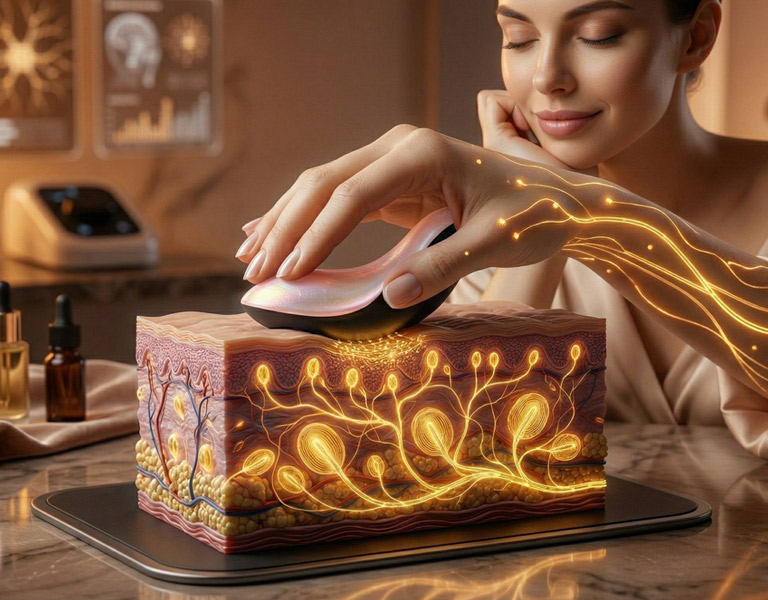
The human skin in the pelvic area possesses an extremely high density of mechanoreceptors. Particularly vital are the Meissner corpuscles (responsible for fine touch and low-frequency textures) and the Pacinian corpuscles (specialized in detecting high-frequency vibrations). The latter respond optimally to frequencies between 30 and 800 Hz. Overly blunt or monotone stimulation can "numb" these sensors, whereas the correct frequency range optimizes neural signal conduction.
The "Jackhammer" Myth: Why Less is Often More
We’ve all seen the cliché of the high-power device that feels more like construction equipment than a wellness tool. Neurologically speaking, constant, monotonous high-frequency stimulation leads to habituation – the brain eventually categorizes the stimulus as "noise" and tunes it out.
Scientific Fact: According to the Journal of Neurophysiology, our nerve pathways process modulated stimuli (changing rhythms and varying frequencies) much more efficiently. Aiersha devices utilize smart algorithms designed to prevent this neural adaptation, ensuring long-term sensitivity and deeper engagement with the nervous system.
Expert-Check: Your Body's "Hardware"
- Meissner Corpuscles: These detect light touch, textures, and slow movements across the skin.
- Pacinian Corpuscles: These are the "vibration masters," reacting to deep pulses and rapid pressure changes.
- A-beta Fibers: The high-speed "biological highways" that carry tactile information directly to the somatosensory cortex in the brain.
Technology You Can Truly Feel
Explore our collection developed on neurological insights—for sensations that go deeper than the surface.
Scientific References & Validation:
- The Journal of Physiology: Mechanoreceptors and touch sensitivity studies. [View Journal]
- Nature Neuroscience: Neural coding of tactile stimulus and frequency perception. [Expert Portal]
- Society for Neuroscience (SfN): Sensory systems and the biology of perception. [Technical Source]